




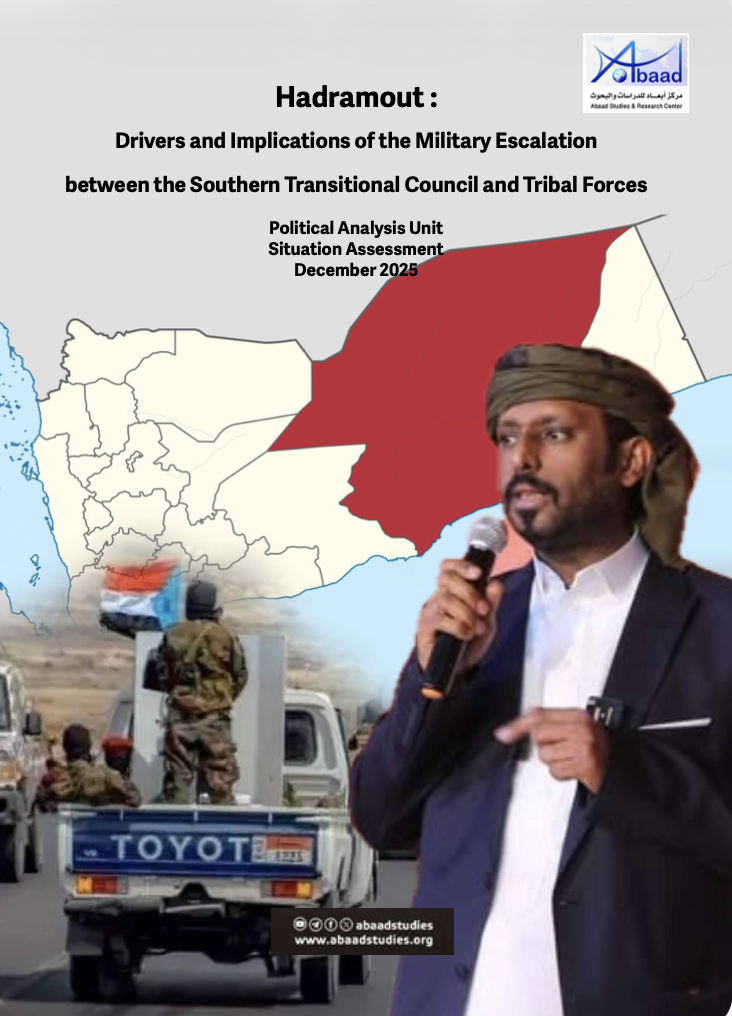
Hadramout:.. Drivers and Implications of the Military Escalation between the Southern Transitional Council and Tribal Forces
Abstract
Hadramout is currently witnessing heightened tensions that have placed the governorate at the forefront of Yemen’s political and media scene. Beyond the current escalation, several strategic, economic, and geographic factors underscore the significance of Hadramout: it is the wealthiest governorate in terms of oil production, the largest by land area, and it occupies a critical location—bordering the Arabian Sea to the south and Saudi Arabia to the north.
Over the past decade, a range of Hadrami political and social entities have emerged, each advocating for greater autonomy and for Hadramout’s right to govern its own affairs as a distinct political, economic, and geographic unit. Among the most notable are the Hadrami League, the Hadrami Uprising (al-Habbah), the Hadramout Inclusive Conference, the Hadramout Tribal Alliance, and the Hadramout National Council. The governorate also hosts branches of Yemen’s major political parties, the Southern Movement, and newly formed political bodies such as the Southern Transitional Council (STC), which calls for the secession of South Yemen.
This analysis examines the recent developments in Hadramout, sheds light on the most prominent local actors, and assesses the influence of regional powers that shape the Hadrami scene.
Geography and Strategic Importance
Hadramout is located in southeastern Yemen, bordered by the Arabian Sea to the south, Al-Mahra to the east, Saudi Arabia to the north, and the governorates of Shabwa, Marib, and Al-Jawf to the west.
Covering roughly 36% of Yemen’s total landmass—approximately 555,000 square kilometers—it is the country’s largest governorate. Hadramout comprises 28 districts divided between the coastal plain and the inland valley region. Mukalla, the provincial capital, is the main urban center on the coast, while Tarim and Seiyun are the principal cities of Wadi Hadramout.
The governorate has a 620-kilometer coastline along the Arabian Sea and hosts several key ports, most notably Mukalla Port and the Ash-Shihr (al-Dabba) terminal. Ash-Shihr, established in 1993, is one of Yemen’s three primary crude-oil export points—alongside Balhaf on the Arabian Sea and Ras Isa on the Red Sea—and serves as the main shipping terminal for oil produced in Masila, eastern Shabwa, Hajarim, and nearby fields.
Hadramout is also home to Yemen’s most productive oil reserves. The governorate alone accounts for more than 80 percent of the country’s crude oil production[1] . The Masila fields, which began operations in 1993, remain Yemen’s largest and most strategically important oil-producing area.
Political Actors in Hadramout
In recent years, Hadramout has witnessed the rise of several political and social entities advocating for the governorate’s rights. Some of these groups focus primarily on service-related and civil demands, while others advance broader political visions concerning Hadramout’s future. The following is an overview of the most prominent actors to emerge over the past decade, along with the core ideas shaping their agendas.
The earliest of these entities was the National Organization for the Liberation of Hadramout (HATUM), founded in 2003 by Abdullah Saeed Bahaj. HATUM called for the right of Hadramout’s people to self-determination and the restoration of an independent Hadrami state[2]. In the years that followed, other groups advocating for Hadramout’s cause appeared, including the Hadramout Rescue Front, the Hadrami National Gathering, the Hadramout Youth Awakening Bloc, the University Youth Coalition, the Free Hadramout Youth Alliance, and the Hadramis for the South. These movements would later form the basis for the Hadrami Forces League, announced in May 2012[3].
The Hadrami League maintains that Hadramout holds a natural and legitimate right to reclaim its historical status as an independent political entity—not subordinate to either northern or southern Yemen—a right it views as inherent, regardless of whether a formal political settlement is reached in the near term [4].
In December 2013, the Hadramout Tribal Alliance launched the first “Hadrami Uprising” (al-Habbah) following the killing of Sheikh Saad bin Habrish, the leader of the Al-Humoom tribe, near a security checkpoint. The uprising’s leadership issued a set of demands that included handing over those responsible for Habrish’s death, withdrawing military and security forces from local checkpoints and replacing them with tribal units, improving public services, and empowering Hadramis to govern their own districts and provide security for foreign companies operating in the region.
Since then, Hadramout’s political demands have expanded considerably. Today, both the Hadramout Tribal Alliance and the Hadramout Inclusive Conference—established in April 2017—stand as two of the most influential local actors, enjoying broad popular support across the governorate.
A second uprising began in December 2021, triggered by severe economic deterioration and worsening living conditions. The movement started with the Harw Conference in Wadi Hadramout and escalated to the Al-Uyoon sit-in on the plateau administratively linked to the Hadramout coast.
In June 2023, the Hadramout National Council was established following a series of consultations hosted in Riyadh. The council’s founding statement described it as “the political representative of the Hadrami community’s aspirations.” The closing session—attended by the Saudi ambassador to Yemen, Mohammed Al-Jaber, and the governor of Hadramout—also witnessed the release of the Hadrami Political and Rights Charter, outlining key principles affirming the people’s right to manage their political, economic, security, social, and cultural affairs[5].
Drivers and Implications of the Escalation
Hadramout has witnessed a notable escalation of tensions in recent weeks, particularly following the arrival of Saleh bin Sheikh (also known as Abu Ali al-Hadrami), a controversial figure backed by the UAE. He arrived with a new contingent brought from outside the governorate under the banner of the “Security Support Forces.”
Bin Sheikh, who previously served as a key intermediary between Iran’s Islamic Revolutionary Guard Corps (IRGC) and the Southern Movement prior to the outbreak of war in 2015, has begun mobilizing social figures and tribal leaders aligned with the Southern Transitional Council (STC). He has issued direct threats against the Hadramout Tribal Alliance, led by Sheikh Amr bin Habrish, who also holds the position of deputy governor.
These threats have coincided with the deployment of STC-aligned military reinforcements from Aden, Lahj, and the western coastal regions toward Hadramout. Analysts suggest that these moves reflect an STC strategy to expand its territorial influence, with the Hadramout coast likely representing a first target. This effort challenges areas currently under the control of the Hadramout Protection Forces, which remain affiliated with the Tribal Alliance.
In response, the Hadramout Tribal Alliance held a broad consultative meeting on 27 November, framing the STC’s advances—particularly through its new “Security Support Forces”—as an escalation requiring collective action. Meanwhile, the STC continues to mobilize forces from multiple regions as part of what appears to be a broader campaign to impose a new power balance in Hadramout.
Two days after its large consultative meeting—during which it assigned its forces the mission of defending Hadramout—the Hadramout Tribal Alliance deployed units to secure the Masila oil fields, aiming, according to its statement, to “reinforce security and protect national resources from any assault or external interference.” The statement added that Hadramout is facing “a clear attempt to seize control of the governorate and its oil reserves,” noting that external groups have begun positioning themselves at strategic sites, taking over certain military camps, and sidelining their local commanders.
The head of the Tribal Alliance said the move was preemptive, intended to protect the oil fields from incoming military reinforcements brought from outside the governorate. He described these forces as “illegal units” receiving direct Emirati support on behalf of the Southern Transitional Council (STC).
In a BBC interview on 1st of December, Sheikh Amr bin Habrish stated that Hadramout is currently “under invasion by tribes from other governorates,” particularly from al-Dhalea and Yafa‘, adding that the forces deployed by the STC to seize control of the oil fields are illegal and lack any legitimate mandate. He stressed that the Tribal Alliance’s actions constitute self-defense, and he urged the international community and regional actors to support Hadramout’s stability. He also highlighted the longstanding and brotherly relationship with Saudi Arabia, expressing confidence that Riyadh would continue to support Hadramout[6].
Meanwhile, the Second Military Region—which is formally under the Ministry of Defense but aligned with Abu Dhabi—issued a warning against the Tribal Alliance and the forces operating under PetroMasila, describing their takeover of the oil facilities as a “dangerous escalation that cannot be tolerated.” It pledged to “take all necessary measures” and stated that it would “strike with an iron fist anyone who attempts to harm the resources of the people.” [7]
According to analysts, the STC is seeking to expand its territorial control in Hadramout as part of its broader project to “restore the state of South Yemen” that existed prior to unification in 1990. This includes securing oil fields and key facilities, pre-empting any future negotiations on Yemen’s political settlement, and pursuing its long-standing objective of extending its influence into Wadi Hadramout, currently under the First Military Region loyal to the internationally recognized government.
However, the STC’s ambitions clash with those of the Hadramout Tribal Alliance, which aims to preserve the governorate’s distinct identity and secure a form of self-administration run by its own residents. This position reflects a widespread consensus among Hadramis on their right to govern their internal affairs, avoid external power struggles, and prevent the spillover of armed conflict into Hadramout.
At the regional level, Saudi Arabia maintains deep historical ties with the Hadramout Tribal Alliance, the governorate’s tribal leaders, and its social and political figures. The UAE, by contrast, established and equipped the Hadrami Elite Forces, and the STC serves as Abu Dhabi’s primary political and security instrument in Hadramout and other parts of southern and eastern Yemen. These contrasting agendas—local and regional—have generated competing projects, with each actor attempting to shape outcomes in line with its own strategic goals.
In recent years, local actors—supported and guided by regional powers, particularly Saudi Arabia and the United Arab Emirates—managed to maintain a degree of understanding despite periodic flare-ups. However, developments in recent weeks indicate an unprecedented escalation, especially with the arrival of armed units and formations loyal to the Southern Transitional Council (STC) from multiple governorates. Observers view this as a rapid, calculated effort to establish territorial control and expand the STC’s reach across eastern Yemen, particularly in coastal and inland Hadramout and the neighboring governorate of al-Mahra.
Such gains would effectively grant the UAE—through the STC—dominance over the entire southern and eastern coastline along the Arabian Sea, in addition to direct influence over oil resources and fields located near Saudi Arabia’s southern border. For Abu Dhabi, this represents a strategic opportunity it is unlikely to forgo.
The UAE and its allied forces are also taking advantage of the weakness of the internationally recognized Yemeni government, including the fragments of its military and security institutions. This situation is further compounded by Riyadh’s relative silence, influenced in part by Saudi Arabia’s focus on other pressing foreign policy issues—most notably the ongoing conflict in Sudan, which was a key topic during Crown Prince Mohammed bin Salman’s recent visit to Washington.
The escalating tensions in Hadramout carry significant implications both locally and nationally. At the local level, the situation risks erupting into armed clashes between the two main power centers—the STC-aligned forces and the Hadramout Tribal Alliance—jeopardizing the stability of a governorate that has remained relatively insulated from violent conflict in recent years.
At the national level, any escalation in Hadramout would further complicate Yemen’s already fragile political landscape, given the governorate’s strategic and economic importance. Renewed instability in the region would add another layer of complexity to a protracted crisis shaped by more than a decade of war and institutional collapse.
Expected Scenarios
1. Regional Containment (Most Likely)
Under this scenario, Riyadh and Abu Dhabi would intervene directly to pressure local actors toward de-escalation, even as tensions persist and both sides maintain their mobilizations in key areas. While such a temporary status quo is inherently unstable, it currently appears the most probable outcome.
Given Hadramout’s strategic importance, neither Saudi Arabia nor the UAE has an interest in seeing a new conflict unfold along Saudi Arabia’s southern border. Any escalation would also confer both military and political advantages to the Houthis, allowing them to consolidate influence and project strength at the expense of their rivals.
2. Armed clashes
Although currently less likely, this scenario cannot be dismissed. Indicators include the STC’s increasingly confrontational rhetoric and the Hadramout Tribal Alliance’s insistence on defending both its communities and public property. The risk of conflict would rise if the STC’s efforts to expand control are influenced by Emirati strategic interests, particularly in connection with Abu Dhabi’s support for the Sudanese Rapid Support Forces along the western Red Sea. (This scenario has materialized following the recent STC’s takeover of Wadi Hadramout and the areas under the influence of Hadramout Tribal Alliance, and the translation of this analysis was completed after its occurrence.)
3. Formation of a Neutral Security Force
In this scenario, local actors—backed by regional powers—would agree to establish a neutral military and security force. This force would comprise elements from multiple sides but be led by non-partisan commanders under joint Saudi–UAE oversight. Its primary mandate would be to protect oil infrastructure and prevent tensions from escalating into open conflict.
References
[1] Mohammed Abdulmalik, Hadramout Halts Oil Exports, Al Jazeera Net, 26 September 2019. Available at:
https://cutt.us/GVf9c
[2] The Hadrami League, Areeq Encyclopedia. Available at:
[3] Nasser al-Mashjari, Interview with the Head of the Hadramout Rescue Front: “We Have No Connection to North or South”, Mareb Press, 19 January 2013. Available at:
https://marebpress.net/articles.php?id=18886
[4] Ibid.
[5] The Political and Legal Charter Issued by the Hadramout Consultations – Riyadh, 20 June 2023, published by Sawt Hadramout. Available at:
https://www.hdrvoice.com/23885/
[6] Amr bin Habrish, Hadramout Is Facing an Invasion, and Our Move Was Preventive, Barran Press, Monday, 1 December 2025 (accessed 1st December 2025). Available at:
https://barran.press/news/12483
[7] Ibid.